Audio Power Amplifier Fundamentals Introduction
The term amplifier is very generic. In general, the purpose of
an amplifier is to take an input signal and make it stronger (or
in more technically correct terms, increase its amplitude). Amplifiers
find application in all kinds of electronic devices designed to
perform any number of functions. There are many different types
of amplifiers, each with a specific purpose in mind. For example,
a radio transmitter uses an RF Amplifier (RF stands for Radio
Frequency); such an amplifier is designed to amplify a signal
so that it may drive an antenna. This article will focus on audio
power amplifiers. Audio power amplifiers are those amplifiers
which are designed to drive loudspeakers. Specifically, this discussion
will focus on audio power amplifiers intended for DJ and sound
reinforcement use. Much of the material presented also applies
to amplifiers intended for home stereo system use.
Basics
The purpose of a power amplifier, in very simple terms, is to take a signal from a source device (in a mobile system the signal typically comes from a head unit) and make it suitable for driving a loudspeaker. Ideally, the ONLY thing different between the input signal and the output signal is the strength of the signal. In mathematical terms, if the input signal is denoted as S, the output of a perfect amplifier is X*S, where X is a constant (a fixed number). The "*" symbol means” multiplied by".
This being the real world, no amplifier does exactly the ideal, but many do a very good job if they are operated within their advertised power ratings. The output of all amplifiers contain additional signal components that are not present in the input signal; these additional (and unwanted) characteristics may be lumped together and are generally known as distortion. There are many types of distortion; however the two most common types are known as harmonic distortion and intermodulation distortion. In addition to the "garbage" traditionally known as distortion, all amplifiers generate a certain amount of noise (this can be heard as a background "hiss" when no music is playing). More on these later.
All power amplifiers have a power rating, the units of power are called watts. The power rating of an amplifier may be stated for various load impedances; the units for load impedance are ohms. The most common load impedances are 8 ohms, 4 ohms, and 2 ohms. The power output of a modern amplifier is usually higher when lower impedance loads (speakers) are used (but as we shall see later this is not necessarily better).
In the early days, power amplifiers used devices called vacuum tubes (referred to simply as "tubes" from here on). Tubes are seldom used in amplifiers intended for mobile use. Modern amplifiers almost always use transistors (instead of tubes); in the late 60's and early 70's, the term "solid state" was used (and often engraved on the front panel as a "buzz word"). The signal path in a tube amplifier undergoes similar processing as the signal in a transistor amp, however the devices and voltages are quite different. Tubes are generally "high voltage low current" devices, where transistors are the opposite ("low voltage, high current"). Tube amplifiers are generally not very efficient and tend to generate a lot of heat. One of the biggest differences between a tube amplifier and a transistor amplifier is that an audio output transformer is almost always required in a tube amplifier (this is because the output impedance of a tube circuit is far too high to properly interface directly to a loudspeaker). High quality audio output transformers are difficult to design, and tend to be large, heavy, and expensive. Transistor amplifiers have numerous practical advantages as compared with tube amplifiers: they tend to be more efficient, smaller, more rugged (physically), no audio output transformer is required, and transistors do not require periodic replacement (unless you continually abuse them). Contrary to what many people believe, a well designed tube amplifier can have excellent sound (many high end hi-fi enthusiasts swear by them). Some people claim that tube amplifiers have their own particular "sound". This "sound" is a result of the way tubes behave when approaching their output limits (clipping). The onset of output overload in a tube amplifier tends to be much more gradual than that of a transistor amplifier. A few big advantages that tube amplifiers have were necessarily given up when amplifiers went to transistors. First, tubes can withstand electrical abuse that would leave even the most robust transistor completely blown. Also, tube amplifiers use an output transformer to interface to the speaker; such a device provides an excellent buffer (protection to the speaker) in the case of internal malfunction. Modern amplifiers (with no output transformer) occasionally fail in a way that connects the full DC supply voltage to the speaker. If the amplifier does not have adequate protection circuitry built in, the result is often a melted woofer voice coil.
Power amplifiers get the necessary energy for amplification of input signals from your car's alternator and battery. If you had a perfect amplifier, all of the energy it took from the alternator would be converted to useful output (to the speakers). However, in the real world no amplifier is 100% efficient, so some of the energy from the alternator is wasted. The vast majority of energy wasted by an amplifier shows up in the form of heat. Heat is one of the biggest enemies to electronic equipment, so it is important to ensure adequate air flow around equipment (especially so for those units using (passive) convection cooling).
Many amplifiers have a number of features to help monitor the status of the amplifier and also to protect speakers (and the amplifier itself) in the event of an overload condition. Some features include power meters, clipping indicators, thermal overload shutdown, over current protection, etc. Features vary from manufacturer to manufacturer. In addition, there are many variations in how protection circuits are implemented and how much "safety margin" they allow. For example, I tested the clipping indicator on one particular amplifier. The clipping indicator did not come on until there was a substantial amount of clipping actually occurring (as viewed on an oscilloscope). In this case, I did not notice a significant degradation of the sound quality despite the clipping. The manufacturer in this case chose to "allow a little more volume" before actually lighting up the warning light.
MORE POWER DOES NOT NECESSARILY MEAN A SUPERIOR AMP OR BETTER SOUND!
A well designed amplifier in the 200 watt per channel class may
be a better investment than a marginally designed 500 watt per
channel unit.
What are the functional blocks of an amplifier?
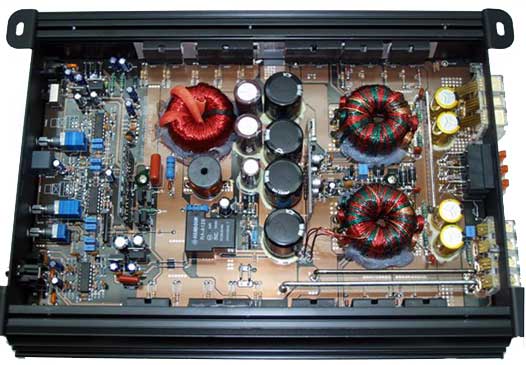
All power amplifiers have a power supply, an input stage, and an output stage. Many amplifiers have various protection features which fall into a category we'll refer to as housekeeping.
Power Supply: The purpose of the supply is to convert the auto's battery voltage to a higher voltage. For example, if an amplifier is to produce 100 watts into a 4 ohm speaker, we need 20 volts RMS. This implies that we need about +/-28 volts. (20 volts R.M.S. = 28.28 volts peak). We call that the "rail" voltage. Since the amplifier's output transistors cannot pull all the way up to this rail, we actually need a slightly higher voltage.
The process is to convert the 12 volts DC into AC, feed it to a transformer and convert it back to DC again.
Converting the 12 volt battery voltage to AC is simple, a PWM (pulse width modulator) IC feeds a bank of MOSFETS (MOSFETs are switching transistors perfectly suited for this task).
The 12 volt power is switched at a very high frequency, somewhere between 40 and 150 kHz. Slower switching speeds require a larger transformer, but high speeds have more switching loss. Advanced transformer core materials, faster rectifiers, and clever winding methods have enabled us to utilize very high frequencies. Some of today's better amplifiers have very small power supplies that produce enormous amounts of power.
Regulated Power Supplies
Most early audio amplifiers contained unregulated power supplies.
Regulated supplies require very high quality filter capacitors
(called "low ESR" capacitors), output chokes, and an
optically isolated voltage feedback circuit. Regulation occurs
by controlling the switching pulse width from 0 - 100% to compensate
for changes in the battery and rail voltage. The same action occurs
when the audio level increases. As the amplifier draws more power
from the supply, the rail voltage drops. Again, the regulator
circuitry senses this drop and responds with an increased pulse
width.
The high frequency PWM waveform is rectified (converted to DC) and applied to the output filter choke and capacitors. This output of this circuit is the + and - DC rails that feed the power amplifier.
Unregulated Power Supplies
Unregulated power supplies are less expensive than regulated supplies.
They do not require an output choke, voltage sense or isolation
circuitry. Because the duty cycle is nearly 100%, capacitor ripple
current is much lower in unregulated supplies. Lower ripple current
requires less expensive capacitors throughout.
Often we hear that unregulated designs have more "headroom". That means that the amplifier will produce extra power during transients. Most home audio amplifiers employ unregulated power supplies. The power supplies in these amplifiers run at 60 Hz, thus the filter capacitors must be 200-500 times larger than those used in high frequency switchers. The extra capacitance in home audio amplifiers results in extra headroom. Headroom for anything other than very short transients simply doesn't exist in the unregulated designs. The following is an example of specifications for an unregulated vs. regulated amplifiers.
Unregulated designs have a higher supply voltage at low power, causing higher voltage on the output transistors. This reduces the amplifier's efficiency.
Small amplifiers (less than 100 watts) cannot justify the extra cost of the regulation circuitry, so we often see unregulated supplies in these amplifiers.
Pros and Cons of Regulated / Unregulated
Supplies
Some designers try to keep their supplies regulated down
to battery voltages as low as 9.5 volts. The supply compensates
by increasing the current. The current increases dramatically at the
lower voltages. Because of higher currents at the lower voltages,
the supply efficiency drops further, requiring even more current.
At higher voltages, the pulse width reduces, causing increased ripple current. This high current creates heat in the filter capacitors and can destroy the capacitor's electrolyte. Some manufacturers do not use capacitors of sufficient quality for this range of regulation. These amplifiers may not perform up to specification just one year after installation. Also, the extra current at low voltages is extra hard on a battery that is already suffering! So, I recommend that amplifiers stay in regulation down to about 11 - 11.5 volts. Any properly working charging system can easily keep the battery voltage well above this.
Input stage: The general purpose of the input stage of a power amplifier (sometimes called the "front end") is to receive and prepare the input signals for "amplification" by the output stage. Balanced inputs are much preferred over single ended inputs when interconnection cables are long and/or subject to noisy electrical environments because they provide very good noise rejection. The input stage also contains things like input level controls (input sensitivity, or gains) Some amplifiers have facilities for "plug in" modules (such as filters); these too are grouped into the input stage.
Bipolar or MOSFET?: We have seen both MOSFET (Metal Oxide Silicon Field Effect Transistor) and Bipolar transistors used in audio amplifiers. Claims have been made that each is superior. I have seen claims that MOSFETs have a tube ("Valve" for the Brits) sound. This is more folklore. The musicians and their instruments are supposed to have "the sound", not audio equipment! MOSFETs are tougher than Bipolars, and can pull closer to the supply rail. It takes more Bipolar transistors to achieve the same power as a MOSFET, therefore Bipolar amps tend to be more expensive. But, MOSFETs are very non-linear, compared to Bipolars and require much more feedback to achieve reasonable distortion numbers. They are a great choice for bass amps, as low frequency audio is not difficult for a MOSFET. The most expensive car and home amplifiers almost always use Bipolar transistors.
Output stage: The output stage of an amplifier is the portion which actually converts the weak input signal into a much more powerful "replica" which is capable of driving high power to a speakers. This portion of the amplifier typically uses a number of "power transistors" (or MOSFETs) and is also responsible for generating the most heat in the unit(unless the amplifier happens to have a very bad power supply design). The output stage of an amplifier interfaces to the speakers.
Efficiency: What makes an amplifier get hot? Both the power supply and the power amplifier generate heat. The maximum efficiency of the power supply is nearly 100%. Good power supply designs, with the highest quality components approach 85%. The class AB amplifier efficiency at full power can approach 75%. The total efficiency, including the power supply, can be about 65%. But, efficiency drops at lower power and can typically be under 20%. A class AB amplifier actually runs cooler at full power than it does at half power. Run this amplifier into clipping and it might run even cooler! Where is all this power going? The output transistor is basically a large variable resistor. If the instantaneous output voltage should be 40 volts and the power supply is 100 volts, then 60 volts must be "wasted" in the output transistors. Driving a reactive load (like a speaker) causes the efficiency to drop ever further. This brings us to the other audio classes designed to improve efficiency.
What are Amplifier Classes?
The Class of an amplifier refers to the design of the circuitry within the amp. There are many classes used for audio amps. The following is brief description of some of the more common amplifier classes you may have heard of:
Class A: Class A amplifiers have very low distortion (lowest distortion occurs when the volume is low) however they are very inefficient and are rarely used for high power designs. The distortion is low because the transistors in the amp are biased such that they are half "on" when the amp is idling. As a result, a lot of power is dissipated even when the amp has no music playing! Class A amps are often used for "signal" level circuits (where power is small) because they maintain low distortion. Distortion for class A amps increases as the signal approaches clipping, as the signal is reaching the limits of voltage swing for the circuit. Also, some class A amps have speakers connected via capacitive coupling.
Class B: Class B amplifiers are used in low cost, low quality designs. Class B amplifiers are a lot more efficient than class A amps, however they suffer from bad distortion when the signal level is low (the distortion is called "crossover distortion"). Class B is used most often where economy of design is needed. Before the advent of IC amplifiers, class B amplifiers were common in clock radio circuits, pocket transistor radios, or other applications where quality of sound is not that critical.
Class AB: Class AB is probably the most common amplifier class for home and mobile audio and similar amplifiers. Class AB amps combine the good points of class A and B amps. They have the good efficiency of class B amps and distortion that is a lot closer to a class A amp. With such amplifiers, distortion is worst when the signal is low, and lowest when the signal is just reaching the point of clipping. Class AB amps (like class B) use pairs of transistors, both of them being biased slightly ON so that the crossover distortion (associated with Class B amps) is largely eliminated.
Class C: Class C amps are never used for audio circuits. They are commonly used in RF circuits. Class C amplifiers operate the output transistor in a state that results in tremendous distortion (it would be totally unsuitable for audio reproduction). However, the RF circuits where Class C amps are used employ filtering so that the final signal is completely acceptable. Class C amps are quite efficient.
Class D: The concept of a Class D amp has been around for a long time, however only fairly recently have they become commonly used. Due to improvements in the speed, power capacity and efficiency of modern semiconductor devices, applications using Class D amps have become affordable for the common person. Class D amplifiers use a very high frequency signal to modulate the incoming audio signal. Such amps are commonly used in car audio subwoofer amplifiers. Class D amplifiers have very good efficiency. Due to the high frequencies that are present in the audio signal, Class D amps used for car stereo applications are often limited to subwoofer frequencies, however designs are improving all the time. It will not be too long before a full band class D amp becomes commonplace.
Class T: Class T (Tripath) is similar to class D with these exceptions: This class does not use analog feed back like its class D cousin. The feedback is digital and is taken ahead of the output filter, avoiding the phase shift of this filter. Because class D or T amplifier distortion arises from timing errors, the class T amplifier feeds back timing information. The other distinction is that this amplifier uses a digital signal processor to convert the analog input to a PWM signal and process the feedback information. The processor looks at the feedback information and makes timing adjustments. Because the feedback loop does not include the output filter, the class T amplifier is inherently more stable and can operate over the full audio band. Most listeners can not hear the difference between class T and good class AB designs. Both class D and T designs share one problem: they consume extra power at idle. Because the high frequency waveform is present at all times, even when there is no audio present, the amplifiers generate some residual heat. Some of these amplifiers actually turn off in the absence of music, and can be annoying if there is too much delay turning back on.
Class G: Class G improves efficiency in another way: an ordinary class AB amplifier is driven by a multi-rail power supply. A 500 watt amplifier might have three positive rails and three negative rails. The rail voltages might be 70 volts, 50 volts, and 25 volts. As the output of the amplifier moves close to 25 volts, the supply is switched the 50 volt rail. As the output moves close to the 50 volt rail, the supply is switched to the 70 volt rail. These designs are sometimes called "Rail Switchers". This design improves efficiency by reducing the "wasted" voltage on the output transistors. This voltage is the difference between the positive (red) supply and the audio output (blue). Class G can be as efficient as class D or T. While a class G design is more complex, it is based on a class AB amplifier and can have the same clean characteristics as well.
Class H: Class H is similar to class G, except the rail voltage is modulated by the input signal. The power supply rail is always just a bit higher than the output signal, keeping the voltage across the transistors small and the output transistors cool. The modulating power supply rail voltage is created by similar circuitry that you would find in a class D amplifier. In terms of complexity, this type of amplifier could be thought of as a class D amplifier driving a class AB amplifier and is therefore fairly complex.
Other classes: There
are many other classes of amplifiers. Most of these are variations
of the class AB design, however they result in higher efficiency
for designs that require very high output levels (500W and up
for example).
At this time I will not go into the details of all of these other
classes.
Why do Amplifiers have different power ratings for different “ohms"?
Power amplifiers are typically rated for "4 ohm" and "2 ohm” loads, and some also give ratings for "1 ohm" loads. If you have ever looked at a spec sheet, you probably noticed that the power output of an amplifier is higher when the load impedance (number of ohms) is lower. Important: a load with a low number of ohms is a more difficult load to amplify than one with a higher number of ohms! (that is, a 4 ohm speaker is harder for an amplifier to drive than an 8 ohm speaker). The performance of an amplifier with low impedance loads is closely related to the capabilities of its power supply.
If we had a perfect amplifier (and it was plugged into an outlet that had unlimited current capability), its output power rating would double each time the load impedance was halved. For example, let's say the amplifier puts out 200 watts per channel at 8 ohms. At 4 ohms, it would put out 400 watts per channel, at 2 ohms it would put out 800 watts per channel, and at 1 ohm it would put out 1600 watts per channel. For the perfect amplifier, one could keep going with this until the load impedance approached zero, at which time the amplifier output would approach infinity! On the other side, if the load impedance was 16 ohms, the amplifier would put out only 100 watts per channel. In this direction, one could keep raising the load impedance, and the power output would grow smaller and smaller.
The power supply of the perfect amplifier generates a DC voltage that does not change no matter how much current is demanded from it. This means that the perfect amplifier can drive an unlimited number of speakers. In the real world, amplifiers have real power supplies which do have limits as to how much current they deliver. For such typical amplifiers, the 2 ohm power rating is usually about 50% more than the 4 ohm rating. Amplifiers with exceptional power supply designs will do better than this, but eventually a limit will be reached (if by nothing else the alternator can only deliver so much current!). Lesser designs will "run out of juice” when driving the heavier loads. Stay away from amplifiers that have a 2 ohm rating that is less than 25% greater than the 4 ohm rating!
Amplifiers utilizing exceptional power supply designs will invariably be the more expensive units available, and possibly the (physically) heavier designs. This is because good power supply designs usually require heavier and better (low loss)"magnetics". All power supplies utilize some combination of transformers, rectifiers, capacitors,and in the case of so called "digital" amplifiers, switching components.
"Analog" Amplifiers: An analog signal is a continuous wave signal, a digital signal is an analog signal which has been converted to a sequence of numbers. Analog when spoken in terms of power amplifiers typically refers to the design of the power supply, and most analog amps are those with a straight Class AB design. A so called analog amplifier has a power supply which typically uses a large power transformer, and large capacitors. These two basic devices step up the DC voltage from the charging system to a higher voltage (more suitable for the internal needs of the unit), and filter and store energy. These types of power supplies have been around for many years; they are simple and reliable. The downside is that the power transformer is usually large and quite heavy (the transformer core utilizes a considerable amount of iron), and the capacitors (a minimum of two are normally used) are also large and bulky.
"Digital" Amplifiers: When the term digital is associated with a power amplifier, it often refers to the design of the power supply and that the power supply is of the switching type (sometimes referred to as a DC - DC converter). Also, digital amps are often of one of the more exotic classes (class G, H, S, etc). These classes of amplifiers use special switching circuits that change the power supply voltage to the output stage on the fly such that higher efficiency is maintained. NOTE: A digital amp in no way means that it is inherently better at producing sound from "digital" sources such as CD's and DAT's!!! I don't recall any manufacturers calling their amplifiers "digital", but I have heard salespeople use this term. What advantages do a switching power supply offer? They are able to use much smaller transformers and capacitors, and are therefore considerably smaller and lighter than an equivalent analog power supply. The concepts behind switching power supplies have been known for many years. However, until fairly recently the components necessary for switching power supplies were unable to be produced cheaply enough for consumer use. Advances in transistor technology have made the necessary devices available at a cost which permits their widespread use. (Note:ALL of the "super systems" heard in automobiles today are powered by amplifiers using switching power supplies).
On the minus side, switching power supplies are a great deal more complicated than their analog counterparts. They work basically by first creating a "crude" DC voltage. This crude voltage is applied to a circuit which uses a specially designed high frequency transformer. A control circuit monitors the output voltage of this stage and makes adjustments "on the fly” in order to keep the final DC output voltage as close to the design value as possible. So, the advantages of lighter weight and smaller size come at the expense of increased part-count(which ultimately might translate to less reliability if the parts are of lesser quality). Also, switching power supplies are harder to repair if they fail.
Many "digital" amplifiers also use a "multi-rail" power supply system. Such systems are more complicated than conventional amplifier designs, however they offer considerable improvements in amplifier efficiency. The amplifier selects a "rail voltage” based on the output demands of the amplifier. Higher efficiency is achieved by minimizing the voltage drop across the amplifier’s output transistors. Since less of the amplifier's power is wasted as heat, the power supply and transistor heat sinks do not have to be as large as those in a "conventional" design. As before, the theory behind "digital" designs has been known for decades, but until recently components necessary to make unaffordable design were unavailable.
"Analog" vs. "Digital"... Which is better?
Many of the amplifiers on the market today are of the "digital" type, using switching power supplies and/or special power supplies that maintain high efficiency at high outputs. Some people believe that "digital" amplifiers are not so good at producing powerful bass notes. While it is true that there are probably some marginally designed "digital" amplifiers which do have less than ideal bass response, weak bass response is not a necessity of digital designs. The dominating factor in performance comes back to the ability of the power supply to provide adequate current; a solid design means adequate current is available for loud bass notes and/or difficult speaker loads. In addition, a second important factor is the adequacy of the charging system. Two well designed amplifiers (one of each type) operated on a DC voltage rail which doesn't "sag" should both provide excellent sound quality. Many of the higher power amplifiers available today are of the "digital" (switching power supply) design. But keep in mind that this does not necessarily make them better or worse. Stay with vendors that have proven track records of reliability and you should have few problems with either type of design.
Power Ratings
Two amplifiers with the same power rating put out the same power, right? Not necessarily. Manufacturers vary as to how conservatively they rate their amplifiers. As an example, I measured one particular amplifier, rated at 350 watts/channel, and found it actually was able to put out 450 watts/channel! Manufacturers often understate what their units will actually putout. It would be a bad idea to publish the "absolute maximum power" that the unit could put out, since a margin needs to be allowed to insure that all production units will meet published specs. In addition, a manufacturer may publish a very conservative 4 ohm rating in order to make the 2 ohm rating look better (a really terrible amplifier will put out LESS power into a 2 ohm load!).
Amplifiers are generally rated in watts per channel , at several load impedances, with both channels driven, over a frequency range of usually 20 Hz - 20,000 Hz, at some amount of total harmonic distortion. Most amplifiers will put out slightly more (but not a tremendous amount more) power when only a single channel is driven. This occurs because the power supply only has to provide power for a single channel, and its DC voltage doesn't sag as much. The exception is amplifiers which use dual independent power supplies (since each of their supplies only has to supply power for one channel anyway).
A word on speakers is in order. All speakers have a characteristic known as impedance (measured in ohms), with most speakers being either 8 ohms, 4 ohms or 2 ohms. Lower impedances represent more difficult loads for amplifiers to drive. Two 4 ohm speakers connected in parallel will result in a 2 ohm load at the amplifier. And, two 2 ohm speakers(wired in parallel) result in a 1 ohm load. In actuality, speaker impedance can vary by a factor of 10 or more over the audio frequency range. When a speaker is said to be 8 ohms, it is understood that this is a nominal or approximate rating (the same goes for 4 ohm speakers). An 8 ohm speaker could have an impedance as low as 2 or 3 ohms and as high as 50 ohms (impedance is frequency dependent)! Further, a speaker load is not the same as a resistive load, speakers are reactive loads. A reactive load is a load that has inductive or capacitive properties. Depending upon the input signal frequency, speaker loads may be resistive or resistive with an inductive or capacitive component. Without going into a ton of technical explanation, what this means is that speakers are often difficult loads for amplifiers to drive. Driving difficult speaker loads is where better amplifiers are separated from lesser designs.
Even though an amplifier may be rated for continuous use at 2 ohms, there are several reasons why this is not the best thing to do:
Paralleled speaker loads may be lower than you think: As stated before, the actual impedance varies and the minimum impedance may dip considerably below 2 ohms at certain frequencies. Lower impedance loads mean more losses and more heat dissipation in the amplifier (see next item).
Heat Considerations: Operating an amplifier with a low impedance load increases the heat dissipation of the amplifier (try it if you don't believe it!). This is because low impedance loads require more current, which taxes the amplifier’s power supply more severely. More current means more losses(which translates to more heat). Excessive heat is unhealthy for electronic devices and should be avoided.
Increased Line Losses: As the speaker impedance is lowered, more of the audio signal is lost (in the form of heat) in the speaker cables! This can become significant if you run long cables. Speaker wires have resistance (the value depends on the thickness and length of the cable); if the speaker impedance becomes very low the resistance of the speaker wire may no longer be insignificant. To prevent this problem, the cross sectional area of the speaker cable conductor must double for each halving of speaker load impedance! In other words, running 2 ohm loads means using VERY heavy speaker cables.
Damping Factor degradation: Using super low impedance loads on an amplifier will degrade the system's damping factor (discussed in detail below). Degradation of damping factor means that the amplifier will have less "control" over the speaker system, possibly resulting in "boomy" bass response.
So, just because an amplifier has a super powerful 2 ohm rating, don't look for ways to wire up multiple speakers in order to "use" this power! Treat the 2 ohm rating as "headroom" and know that your amp has the ability to more easily handle the most difficult "normal" speaker loads that you are likely to ever encounter. If you need more power, get a second amp. Two medium powered amps are better than one monster (what if your one big amp dies? With two smaller amps at least you can still run!).
Noise
All amplifiers generate a certain amount of electrical noise. Generally, the more powerful the amplifier, the more noise. If you turn on an amplifier (with the input jacks disconnected) and listen to a speaker you can clearly hear a hissing sound. This pretty much represents the noise floor of the amplifier. For a powerful system, the noise might seem pretty obvious; however when actual music is playing the noise will be totally masked.
All electrical circuits generate a certain amount of noise. Better designs minimize the amount of noise, however no matter how good the design there will always be some. The noise is generated by the movement of electrons in the system and cannot be eliminated (unless you chill your equipment to absolute zero!). The noise floor of an amplifier by itself is usually not obviously audible in a typical car (unless you are sitting right next to a speaker). However, the remaining components in a system (preamp, equalizer, processors, etc.) each add in some noise. So, the total system noise (when no music is playing) might be objectionable. If this is a serious problem, a device called a noise gate can be used. Such a device is essentially a "squelch" which is wired in just before the power amps (or electronic crossover in multi-way systems). The device basically cuts noise from upstream components when no music is playing. Most noise gates have adjustable controls to set the threshold at which noise cut begins and also to set the amount of desired noise cut.
The noise floor of an amplifier is relatively constant, meaning it does not increase with increasing output signal (unless the amplifier has a poorly regulated power supply). In other words, the amplifier's noise floor is pretty much the same whether or not music is playing loudly or softly. So, when music is playing softly, the noise will be proportionally larger. When music is playing loudly, the noise is essentially "buried" or masked.
As stated, an amplifier with a poorly regulated power supply can create some additional noise. If the filtering of the power supply is marginal, the "smoothness" of the DC power supply voltage will be degraded when the amplifier is playing loudly. This will result in additional noise being added to the system (generally in the form of alternator whine). This type of noise isn’t really part of the noise floor. Such noise is often inaudible when music is playing loudly. It can be clearly heard however when playing test tones at levels near the output limit of the amplifier (don't try this unless you are thoroughly familiar with testing practices... blown speakers will otherwise be the result!).
Distortion
ALL amplifiers alter input signals, generally in two ways: they make them stronger (amplify them), and they add characteristics which did not exist in the original signal. These undesirable characteristics are lumped together and called distortion. Noise can be considered a type of distortion and was discussed in the above section.
Everyone is familiar with gross distortion, the sound quality that results when turning up a radio or boom box to "full blast”. An excessive amount of amplifier clipping (see section below) results in hideous distortion that would be totally unsatisfactory for a sound system. However, not all distortion is blatant. In addition, there are several types, two of which will be discussed. Knowing what causes distortion will help you to prevent it from occurring. Knowing how to control distortion is important because excessive distortion can be detrimental to speaker systems (and your reputation).
Harmonic distortion:
One common type of distortion is harmonic distortion. Harmonics of a signal are signals which are related to the original (or fundamental) by an integer (non decimal) number. A pure tone signal has no harmonics; it consists of only one single frequency. If 100 Hz pure tone signal was applied to the input of an amplifier, we would (upon measurement with special test equipment) find that the output signal of the amplifier was no longer pure. Careful measurements would likely show that several "new" frequencies have appeared. These new frequencies are almost certain to be integer multiples of the original tone; they are the harmonics of the original signal. In the case of a 100 Hz input tone, we might expect to find tones at 200, 300, 400, 500 (etc.) Hz. We would also probably notice that the odd harmonics are much stronger than the even harmonics (we will not go into the reasons why in this article). In a good amplifier, the harmonics will be much weaker than the original tone. By much weaker, we mean on the order of a thousand times for decent amplifiers.
All amplifiers are generally rated for Total Harmonic Distortion (or THD), usually at full power output over a given frequency band with a particular load. Good values are anything less than 0.5% THD. When an amplifier is measured for THD, a pure tone is applied to the input and the output is measured with special test equipment. The energy of the pure tone is measured, and the energy of the harmonics is measured. Those two values are compared, and a THD rating is calculated. A THD rating of 1% means that the total energy of all the harmonics combined is one one-hundredth of the energy in the fundamental.
Harmonic distortion (although certainly undesirable) is one of the more tolerable types of distortion as long as it is kept reasonably low. Distortion levels of 10% may be very tolerable with music so long as the 10% level is only "occasional." (10% THD on a pure tone can easily be heard by the human ear... but who listens to pure tones?) The reason that a seemingly high value of THD is acceptable for music is partially because many sounds in nature are rich in harmonics. Also, most decent cassette decks (which most people agree sound pretty good) have THD (off the tape that is) of several percent. Worse, even good speakers can have THD up to 10%, especially at low frequencies! All in all, the human ear can tolerate a fair amount of THD before it becomes objectionable.
Do two amplifiers with identical THD ratings sound the same, everything else being equal? Not necessarily (but differences will be subtle). The reason is that the THD specification states nothing about where the harmonics are in the frequency band. For example one amplifier could have a dominant harmonic at one frequency and a second amplifier could have a dominant harmonic at a very different frequency. Or, one amplifier could have a few "big" harmonics while a second has many weak ones. These situations could easily result in identical THD ratings. The variations could be easily measured with laboratory equipment. However do not be overly concerned. Minor variations in THD ratings will not cause major differences in sound when listening to music. With pure tones as input signals it might be fairly easy to discern which of two amplifiers was used (but again, who listens to tones?)
Intermodulation distortion: Intermodulation distortion is the second "major" type of distortion that is often specified for amplifiers. Intermodulation distortion is much more objectionable to the human ear because it generates non-harmonically related "extra" signals which were not present in the original. It is analogous to someone singing way off key in a choral group
Intermodulation distortion (sometimes abbreviated IM) is more complicated to test for and specify. Basically, two pure tones are simultaneously applied to the input of the amplifier. If the amplifier were perfect, the two tones (and only the two tones)would be present at the amplifier output. In the real world, the amplifier would have some harmonic distortion (as described above), but careful observation of the output signal (using laboratory equipment) would reveal that there are a number of new tones present which cannot be accounted for as a result of harmonic distortion. These "new" tones are called "beat products" or "sum and difference" frequencies, and are a result of the interaction of the two pure tones within the amplifier. No amplifier is perfect, all have some non linear characteristics. Whenever two signals are applied to a nonlinear system, new signals (in addition to the original two) are generated. For a good amplifier, the new signals are very small in relation to the two original tones. This is fortunate, since the ear can detect much lower levels of intermodulation distortion as compared to harmonic distortion.
It should be noted that distortion measurements on amplifiers are made with test tones. These tones are usually sine waves (pure tones), which represent the simplest possible test signal to measure and quantify. A music signal is an extremely complicated waveform consisting of many constantly changing sine waves. Since music has so many harmonics and frequencies present, quantifying how two different amplifiers will sound by using simple THD and IM specifications is extremely difficult. In other words, just because two amplifiers have the same published specs for THD and IM does not mean that they are equivalent. Fully and completely quantifying the technical performance of an amplifier would be extremely complicated and costly (and would probably have little benefit in the end). Most amplifiers available today (from reputable manufacturers) have THD and IM levels low enough to yield excellent performance (so long as they are not overdriven). This leads nicely into our next topic...
Clipping: What is this?
Clipping is a term which many people have probably heard, but may not fully understand. Very simply, clipping of an amplifier occurs when one tries to get a larger output signal out of an amplifier than it was designed to provide.
As stated before, all power amplifiers have a DC power supply which provides power to (among other things) the output stage of the amplifier. For most amplifiers, the power supply consists of a "plus" supply and a "minus" supply. The two voltages are often referred to as "rail voltages" or simply "rails". As an example, a 200 watt per channel amplifier (at 4 ohms) might have a power supply voltage (rails) of +/- 120 volts DC. This means that the output voltage which drives the speaker can never exceed + 120 or - 120 volts. If the amplifier is playing at near full volume, and someone cranks up the volume, the amplifier will attempt to put out more power. However, the power required to meet the sudden new demand for more volume cannot be met by the power supply voltage, which has limits of +/-120 volts in this example. The result is a waveform with the top portion (or peak) "clipped" off (hence the term "clipping"). Such clipping represents a distortion which is added to the waveform (and if it is severe enough it will be clearly audible). If a signal is severely clipped, the waveform takes on the shape of a "square wave", and the resulting sound will be absolutely hideous. Clipping can be easily observed using an oscilloscope attached to the amplifier output.
Clipping is not usually a major problem for amplifiers (unless it is extreme), but it can be very detrimental to speakers. Whenever clipping occurs, two things happen: (1) the spectral content of the music signal is altered (high frequency components are generated), and (2) signal compression occurs. If excessive clipping occurs, tweeters will be the first to blow followed by midrange drivers. Woofers are best equipped to survive clipping (unless the abuse is blatant or the subs are poorly designed.)
In general, clipping of an amplifier should be avoided. Use an amplifier that has clipping indicators, and pay attention to them! Occasional clipping is OK and probably not very audible. However if you find yourself clipping the amp most of the time, you should consider obtaining a stronger (or additional) amplifier.
Damping Factor... What is this?
The Damping Factor of an amplifier in general refers to the ratio of the amplifier's output load impedance (the speaker, nominally 4 ohms) to the output impedance of the amplifier. Ideally, the damping factor would be infinity (in other words, the ideal output impedance for an audio amplifier is zero ohms). Damping factor, like many amplifier specifications, is a function of many factors and is thus difficult to quantify with a single number. As such, "low end" manufacturers can have a "field day" with this spec, publishing fantastic numbers (however with no information as to how the measurement was made).
The damping factor of an amplifier depends greatly upon the speaker to which it is connected, the wire connecting the speaker to the amplifier, the signal frequency that the amplifier is sending to the speaker, and the power level at which the amplifier is operating, among other things. Damping factor is most critical at low frequencies, generally 100 Hz and below (i.e. frequencies that a woofer reproduces). At such frequencies, a high damping factor is desirable in order to maintain a "tight" sound. If an amplifier/speaker pair has a low damping factor, the bass response is likely to be "boomy", "uncontrolled", and "loose" sounding.
Specifying damping factor as a simple single number does not really tell the whole story. Damping factor is a ratio of two numbers, one of which (the speaker impedance) varies by a large amount depending upon frequency. This being the case, the damping factor will also vary considerably as a function of frequency. Most of the variation in damping factor is due to the characteristics of the speaker connected to the amplifier. The wire which connects the speaker to the amplifier has finite resistance which must be accounted for; basically it is lumped in with the impedance of the speaker. So, it is wise to use heavy speaker wire in order to minimize degradation of the damping factor.
As mentioned, the output impedance of an amplifier is ideally zero. In the real world, this is never the case. The next best thing would be a very low constant (non changing) impedance. Again, the real world does not allow this either. The output impedance of most amplifiers is relatively constant except for when they approach the last 10% or so of their voltage output. This is due to the nature of the waveform from which most power supplies obtain their energy (especially analog supplies) . What this means is that the output impedance of an amplifier tends to rise considerably as it approaches its output limit. As the amplifier's output impedance increases, the damping factor must decrease proportionally. In my opinion, if manufacturers specified the output impedance of their amplifiers, there would be a lot less ambiguity among the numbers.
High damping factor numbers
go hand-in-hand with amplifiers that can drive very low impedance
loads (these are amplifiers with power supplies capable of delivering
tremendous current). If you want to "artificially" degrade
the damping factor of your system (to hear the effects), a simple
test can be done:
Listen to your system at a "healthy" volume (use a CD
with lots of low, tight percussion type sounds); be sure to use
a heavy gauge short length speaker wire. If you have a sound level
meter, note the sound level at which you listened. Then, connect
your speaker up through a 100 foot (give or take) wire with much
smaller gauge (use #20 or higher). Play the same music as before,
but make sure the volume (to your ears, not the volume control!)
is the same (this is where the sound level meter comes in handy).
The volume control on the amp will have to be turned up a bit
to overcome the power loss in the smaller wire. You should be
able to tell that the sound has changed (for the worse, in most
people's opinion).
Do not be terribly concerned with damping factor when choosing quality equipment. Most of the good amplifiers and speakers available today will yield excellent sound when used together. To avoid degrading the damping factor of your system, simply follow these (easy) steps:
Don't load up an amp with multiple pairs of low impedance speakers
Use heavy gauge speaker wire, ESPECIALLY in long runs
Never wire resistors in series with your speakers (you can't change a 4 ohm speaker to 8 ohms by doing this!)
Use a heavy duty (i.e. 8 gauge or heavier) power cable wiring your amps.
Can I get a shock from the speaker connections on my Amp?
YES! Amplifiers in the 400
plus watt per channel range are not uncommon today. Such an amplifier
will put out about 50 to 60 volts RMS to a speakers. While this
is only about half the amount that comes out of a wall socket,
it's definitely enough to be unpleasant if you are holding on
to it!
Note: The US Military defines any voltage in excess of 30 volts
as hazardous. Such a voltage can be generated by any amplifier
in the 100+ watt per channel range.
Zapco's C2K series amplifier manuals actually state as a warning
that their amps can produce over 120 volts AC at 60Hz, which is
equal to the output of a wall outlet! Not the sort of thing you
want to test with your tongue.
As a side note, it's not a good idea to plug in or unplug speakers when the amplifier is playing at high volume. The "make and break" of connectors can cause momentary short circuits, as well as voltage and current transients (none of which is healthy for the amp). The preferable procedure is to make all speaker connections (and disconnects) with the amp turned OFF.
What is "Bridging"?
Bridging an amplifier refers to configuring a two channel (stereo) amplifier to drive a single load with more power than the sum of the two original channels combined. For an example, a 100 watt per channel at 4 ohms amp may put out 400 watts(one channel at 4 ohms) after bridging.
There are important things
to know about running an amplifier in the bridged mode:
An amplifier running in bridged mode has one output channel to
which a load (speaker) can be connected. It is no longer a two
channel (stereo) amp as far as input signals and loads are concerned.
If the amp you want to run in bridged mode does not have built
in facilities for doing so, you should not attempt to use it in
this manner (unless you are thoroughly sure of what you are doing).
If you run bridged amplifiers, you must pay close attention to
speaker phasing (see next item). Otherwise, you may have "hollow"
or "weak" sound.
You must pay close attention to speaker wiring. The manufacturer
will state which terminal is really the "positive" connection
when bridged.
The speaker output signals of a bridged amplifier are floating;
such connections must never be connected to any grounded device
(such as an external accessory power meter, for example). If you
do make such an illegal connection, one amplifier channel is basically
short circuited (worst case result is a blown amplifier!).
Amplifiers running in bridged mode are generally limited to speakers
with impedance ratings of no less than 4 ohms (in other words
don't use a 2 ohm speaker load unless the manufacturer specifically
allows it).
Bridged amplifiers work
basically as follows:
A single input signal is applied to the amplifier. Internal to
the amp, the input signal is split into two signals. One is identical
to the original, and the second is also identical except it is
inverted (sometimes called phase-flipped). The original signal
is sent to one channel of the amp, and the inverted signal is
applied to the second channel. Amplification of these two signals
occurs just like for any other signal. The output results in two
channels which are identical except one channel is the inverse
of the other. The speaker is connected between the two amplifier
speaker output terminals. In other words, one channel "pulls"
one way while the second channel "pulls" in the opposite
direction. This allows considerably more power to be delivered
to a single load.
If we had our perfect amplifier,
upon bridging it we would have a single channel amplifier with
exactly four times as much power as any one channel of the amplifier
in "normal" stereo mode, assuming a 4 ohm speaker load.
This is because the effective output voltage available to drive
the speaker has doubled as a result of bridging. A doubling of
voltage on a given load results in a fourfold increase of power
delivered to that load. If we used a 4 ohm load on the perfect
bridged amplifier, the output power would be a very substantial
eight times the normal stereo single channel 4 ohm output! These
numbers should give some clues as to why real world amplifiers
cannot meet such expectations. Once again, we are back to limitations
of the power supply. In reality, most amplifiers in bridged mode
will put out about 3 times the power as any one channel of the
amp in normal stereo mode. The fourfold increase cannot be achieved
because the power supply is unable to provide the current required
for such performance. With 2 ohm loads, the situation is compounded.
The amount of current required to drive a 2 ohm load when in bridged
mode will tax the amplifier’s power supply to its absolute
limits. Not to mention, the output stage may not be able to safely
handle the extra heat that will be dissipated.
Bottom line: stay away from 2 ohm loads if you are running an
amplifier in bridged mode!
Maximum Power Transfer Theory and Efficiency
Note: This section is intended primarily for engineering students or those with a deeper technical interest. The purpose is to provide a "real world" explanation of the Maximum Power Transfer theory and why it is NOT used in amplifiers designed for stereo systems.
Second year electrical engineering students have most likely covered the theory that basically states "maximum power is transferred to a load when the output impedance of the source is identical ("matched") to that of the load." The connection that some people fail to make is that maximum power transfer doesn’t mean maximum efficiency! At best, if the maximum power transfer theory is used, efficiency will be only 50% (not such a good figure for an audio amplifier.) In other words, if an amplifier is designed for maximum power transfer to a load, fully one half of the energy required by the amplifier's output stage will be dissipated (i.e. wasted) in the source impedance.
For amplifiers used in stereo systems (audio amplifiers), the goal is to have the amplifier output impedance be as low as possible (ideally zero, but this is never achieved). If an amplifier were to have an output impedance of 4 ohms (a common value for speakers), maximum power transfer would occur. However two other bad things result. First, the efficiency of the amplifier is at best only 50%, meaning that the amplifier will generate a lot of heat. Secondly, the amplifier/speaker system will have a terrible damping factor. Damping factor basically refers to the ratio of speaker impedance to amplifier output impedance; high numbers are better. A low damping factor will not damage anything but it will tend to louse up the sound considerably. To maintain a "tight" sound, it is important to have the output impedance of the amplifier be as low as possible with respect to the speaker. Otherwise, the amplifier will not have as much control over the speaker. Speakers, being highly complicated electro-mechanical devices with reactive impedance properties, behave better when they are connected to an amplifier with an extremely low output impedance. Speakers tend to electrically "buck and kick" an amplifier when in operation; the best way to tame this behavior is to put a heavy "load" (i.e. an amp with a very low output impedance) on the speaker. An amplifier/speaker combination with a low damping factor will tend to have a "boomier" sound and poorer transient response, (such a sound is not always bad, some people actually prefer it!).
There is a quick test anyone can do to get a feel for what effect the damping factor has on a speaker system. Disconnect your speakers from the amplifier, remove the grille, and gently tap on the woofer cone. You will hear a low frequency sound, this is the "resonant frequency" of the speaker (in it's enclosure.) Note the characteristic of the sound as you tap the cone. Now, connect the speaker up to the amplifier, and turn the amplifier ON (but leave the volume at zero). Now tap on the speaker cone as before. You will observe that the sound has changed considerably. The sound will be much "tighter", and the cone will seem harder to move. This is because the amplifier has in effect "loaded" the speaker. The case where the speaker was disconnected from the amplifier represents the worst possible damping factor (zero).
Anyway, back to the topic of this section. Although there are many applications where maximum power transfer is desired, audio amplifiers are not one of them. Audio amplifiers generally deal with a considerable amount of power, so high efficiency is a more important design consideration. In addition, to maintain high quality audio, an audio amplifier ideally has an output impedance which is VERY small compared to the impedance of the speaker it will be driving. Note that using 2 ohm speakers on an amplifier will degrade the damping factor as compared to using 4 ohm speakers (total load.)
portions of this article courtesy of Joe Roberts
