Rear-fill speakers
While rear speakers might seem natural or necessary to some people, it is deemed undesirable and at best useless to those who are into good sound quality. There is nothing inherently evil about rear speakers, it's just that rear speakers often interfere too much with the ability of the front speakers to produce a believable sound stage and imaging characteristics. These effects can be minimized if care is taken to set up the rear speakers, but they are still there.
First, we discuss the "purist" view on rear speakers. Rear speakers grew out of necessity rather than the pursuit for better sound quality. A lot of cars, especially compacts and sub-compacts, have very small speaker openings in the front of the car due to space restrictions. It is rather rare to find a stock speaker location that can fit something as desirable as a 6.5 inch driver, while 4" and 4x6" speaker openings are quite popular. Small speakers are usually incapable of producing low bass (below 100Hz) at a satisfying level (say 90dB for casual listening.) Rear speaker mounting locations, especially the rear decks of sedans, offer a lot of area to mount a sizable driver, thus car manufactures rushed to mount large speakers in the rear to fill in the low bass region. This would have worked out if the stock stereos fed a low-pass filtered signal to the rear speakers so that they only produced the low bass frequencies, in which case those rear speakers would be called woofers or subwoofers. But no. Car manufactures didn't want to let all that volume go to waste so they fed the whole signal spectrum to the rear speakers. To make matters worse, the signal sent to the rear speakers is in stereo. The end result is that the center of the sound stage is somewhere to the far-right behind the driver and far-left behind the passenger. The instrument and vocal image floats all over the rear of the listener and shifts dramatically depending on the position of the listener's head. This is not how a live performance sounds.
There are several forms of rear-fill that can be used, with varyingeffect.
1. Simple attenuated L+R: For the reason discussed above, rear speakers can severely interfere with the proper sound stage production and imaging of the front speakers. However, there are measures that can be taken to minimize the effect. The simplest thing to do is to turn down the rear speaker volume. Close your eyes, keep your head straight and adjust the front-rear fader control while you listen to a piece of music with strong central vocal content (check this with your home stereo or sit in the middle of the back seat with the rear volume turned all the way down.) First, turn the rear speaker volume all the way down, and then slowly turn it up until the vocal image starts to drift to the opposite side of the car. If you are sitting in the driver seat, listen for it to drift toward the passenger side and vice versa. This is the point where the rear speakers are still noticeable but it is not interfering too much with the proper operation of your front speakers.
2. bridged mono attenuated signal: Rear speakers should never be allowed to operate in full range unless you are going for DVD-based THX or Dolby Digital AC-3 theater multi-channel setup. If you have a separate subwoofer, band-limit the signal going to the rear speakers to approximately between 200Hz and 3kHz. You don't need complex crossovers for this, just something like a 6dB per octave first-order high-pass filter at 300Hz and a 6dB per octave first-order low-pass filter at 2kHz. We're talking about one coil and one non-polarized electrolytic capacitor ($20 if you get the real snazzy stuff like polypropylene capacitors and low gauge air core inductors). Minimizing the high frequency content of the signal fed to the rear speakers is much more important than the low frequency content. In fact, if you do not have a dedicated subwoofer, you can do without the 300Hz high-pass filter and let the rear speakers produce the bass frequencies. But keep in mind that rear speakers should have a lower relative volume than the front so the effectiveness of the rear speaker to double as a subwoofer is severely limited.
3. delayed, attenuated, band-limited L+R: This is similar to the mono setup described above, but with the addition of a ~20msec delay to the rear signal in order to cause a perceived delay giving the impression of a larger concert hall venue environment.
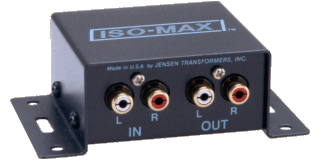
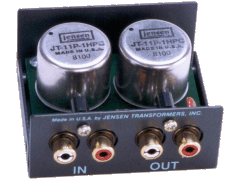
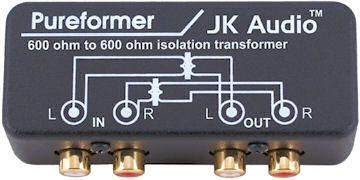
4. delayed, attenuated, bandlimited differential signal, L-R: There is a big difference between a concert hall and car: interior, and that's the acoustic space! This is one method of doing the L-R signal adjustment prior to signal processing:
Some of the things a line transformer will do for you are:
Another simple way to accomplish the L-R differenced signal is through the use of an opamp and a couple of resistors, like so: (circuit diagram)
Of course, you may want to consider the options mentioned above, or go with something like Dolby Pro Logic II (invented by Fosgate with an automotive acoustic space in mind), DTS Neo:6, and the new Harman Logic7 processor for the car (which, by the way, is starting to get some very encouraging reviews). All of these options create a multi-channel signal from a 2-channel source, and make very intelligent use of speakers behind your head. Your cheapest and simplest solution is not to have ANY rear speakers. The next cheapest solution is to keep your stock rear speakers. The reasoning behind this is that most stock speakers are quite OK in the 200Hz to 3kHz region. It is in the bass and high frequency region where they run into trouble. Besides, you are going to be running it low-volume, band-limited and possibly in mono, so the difference between a pair of stock rear speakers and say a $250 pair of high quality mid-bass drivers is not going to be all that noticeable. But again, it is important that you keep it low-volume, band-limited. If you have a lot of money (send me some) and really want a fancy spare-no-expense type of system, then go ahead and find a good solid pair of mid-bass speakers. DO NOT, I repeat DO NOT, I'll say it again DO NOT buy co-axials or component speakers to use as rear fill since you are going to be wasting a lot of money on the useless tweeter and crossovers. You might be rich but you don't have to be stupid. A $200 set of components or co-axials might be just so-so but a pair of $200 mid-bass drivers is going to be killer. A lot of companies make really good mid-bass drivers. Look into Kicker, JL, Boston Acoustics, MB Quart, Audax, or Morel just to mention a few. There are also a few high dollar brands such as Dynaudio, USD Audio, Image Dynamics and Focal. This is not an inclusive list because there are a LOT of good mid-bass drivers out there.
|
|||
| © Copyright WolfWare, Ltd.. All
Rights
Reserved. |